
खेत पर चार ताले।
Four locks on farmland: ceiling, tribal, Bhoodan and government-allotted land
Four restrictions that can stop a farmland purchase in Madhya Pradesh, which law each one sits in, and the three things to do before any money moves.

On this page
Four legal restrictions can stop a farmland purchase in Madhya Pradesh whatever the price: the ceiling on agricultural holdings, protections on land held by members of aboriginal tribes, restrictions on Bhoodan land, and limits on selling land the state granted. None shows on the field. All can be checked against the record.
A field is not a plot
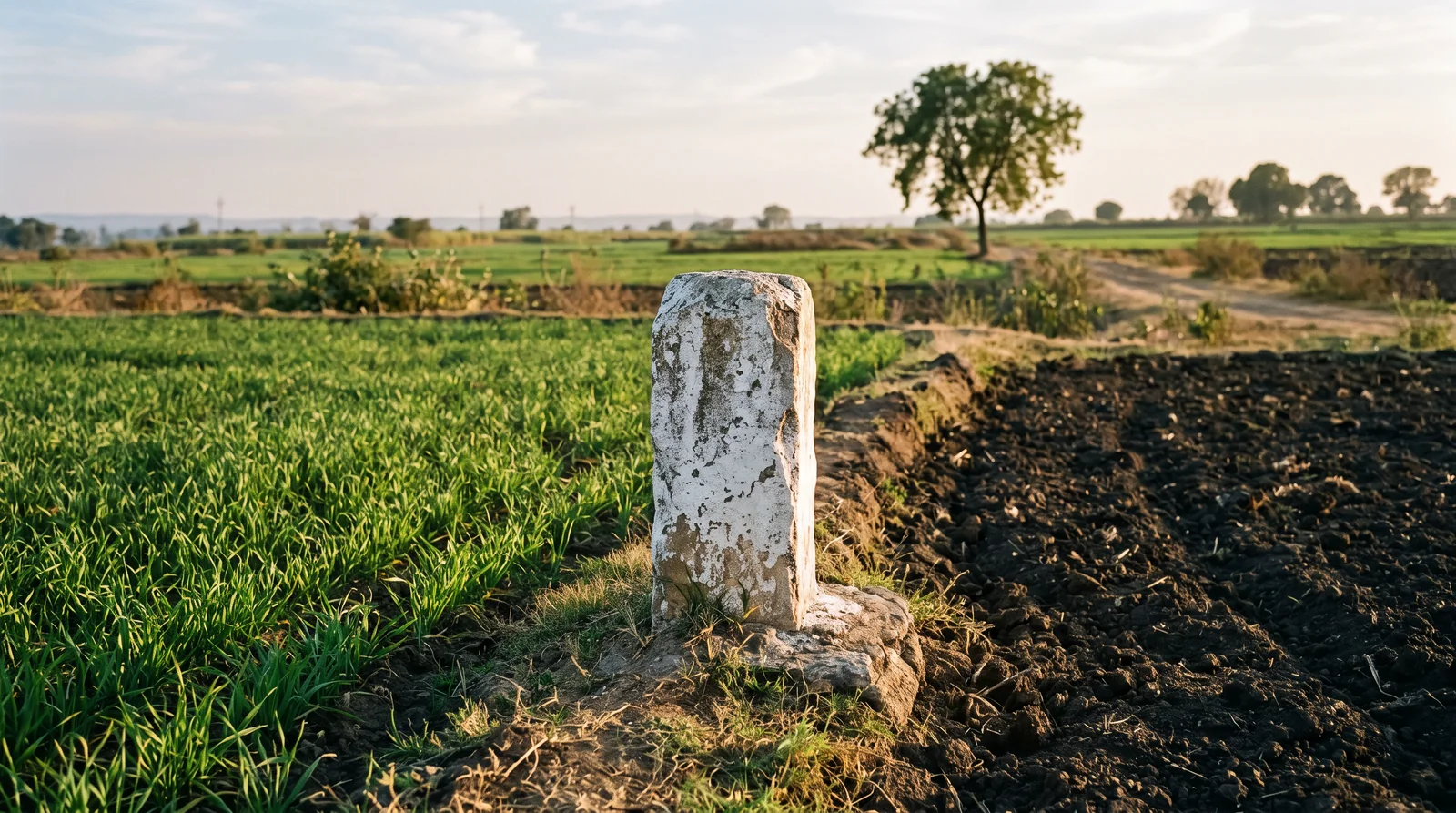
A plot in a sanctioned colony has already been through a process: diversion, layout, permissions. A field has not. Agricultural land in Madhya Pradesh carries limits on who may hold it and who may receive it, and those limits come from separate laws written for separate purposes. A seller can be honest, the price can be fair and the boundaries can be clear, and the sale can still be one the law does not allow.
None of this is visible from the bund. The difference is in the record, and in the law the record points to.

The four locks
Each one sits in a different law. Which of them applies to a given field is a question for a lawyer and the tehsil, and this guide does not answer it for you. What it can do is tell you what to ask.
1. The ceiling on holdings
The law caps the amount of agricultural land a single holder may keep. The point that surprises buyers is whose problem a breach becomes. A purchase that takes you over the ceiling is the buyer's problem, not the seller's. The seller has sold and gone; you are the one holding more than the law allows.
This matters most to people who already own farmland, or whose family does, and are adding to it.
2. Land of members of aboriginal tribes
Land held by a member of a tribe declared an aboriginal tribe is protected. In areas the state has notified as predominantly inhabited by such tribes, the law bars its transfer, by sale or otherwise, to a person who does not belong to the tribe. Outside those notified areas, such a transfer needs the Collector's permission, with the reasons recorded in writing.
The protection exists for a reason, and it is enforced. A sale that skipped it is not a technicality waiting to be fixed later.
3. Bhoodan land
Land that came through the Bhoodan movement, donated by landholders and distributed among landless families, carries its own restrictions on transfer under the state's Bhoodan law. It can sit inside an ordinary-looking village of ordinary-looking fields, and the holder may farm it like any other land. Selling it on is a different matter.
4. Government-allotted or assigned land
Land the state granted to a person for a purpose generally cannot be sold on without official consent, and sometimes not at all. Under the Land Revenue Code, a person who holds land from the State as a Government lessee, or to whom the right to occupy was granted by the State or the Collector, may not transfer it without the permission of a revenue officer not below the rank of Collector.
रक़बा बाद में — पहले रिकॉर्ड।
Raqba baad mein — pehle record.
Three things to do before any money moves
All three come before the token, not after it.
1. Pull the khasra and the B-1 yourself
The revenue record is public and searchable online on the state's land records portal. It carries the holder's name, the area, and any remark that matters. Do not rely on a printout the seller brought. Pull it yourself, and read every column, including the ones that look like bookkeeping. Our walkthrough of pulling your own land record shows how.
2. Ask the four questions directly
Is this land tribal? Is it Bhoodan land? Was it allotted or leased by the government? Will this purchase take me over the ceiling? Ask each one as a plain question, and then get the answer checked against the record, not settled in conversation. A real estate agent who knows the area well will usually know where these questions bite, and a good one will welcome them.
3. Decide what the land is for, before you buy it
If you mean to farm it, the four locks are the main question. If you mean to build on it, there is a second process ahead of you. Diversion, the change from agricultural to another use, is a separate process with its own steps and timelines. Confirm them locally first, and read what diversion changes before you assume a field can become plots.
What this guide does not do
It does not tell you whether any one field is affected. That depends on the record for that survey number and on facts about its history, and both need a lawyer and the tehsil. Treat this as the list of questions to carry into that conversation.
| The lock | The law it sits in | Who decides |
|---|---|---|
| Ceiling on holdings | MP Ceiling on Agricultural Holdings Act, 1960 | Ask the tehsil and a lawyer |
| Tribal land | MP Land Revenue Code, 1959, s. 165(6) | Collector, where permission is possible |
| Bhoodan land | MP Bhoodan Yagna Adhiniyam, 1968 | As that Act provides |
| Government-allotted land | MP Land Revenue Code, 1959, s. 165(7-b) | Revenue officer of Collector rank or above |
Where to check it
See it for yourself on the map — boundaries, plans and paperwork on one screen.
See whether the land sits inside a gram panchayat or a colony, and what the plan intends for it →Questions people ask
Can a non-tribal buy tribal land in Madhya Pradesh?
In areas notified as predominantly inhabited by aboriginal tribes, the Land Revenue Code bars transfer of a tribal holder's land to a person outside the tribe. Elsewhere such a transfer needs the Collector's permission, recorded in writing. Ask a lawyer about the specific field.
Can Bhoodan land be sold?
Bhoodan land carries its own restrictions on transfer under the Madhya Pradesh Bhoodan Yagna Adhiniyam, 1968. Check the record and take legal advice before any money changes hands.
Can government allotted patta land be sold in MP?
Land held from the State as a Government lessee, or granted by the State or the Collector, cannot be transferred without the permission of a revenue officer not below the rank of Collector, and sometimes not at all.
Is there a limit on how much agricultural land I can buy in MP?
Yes, the Madhya Pradesh Ceiling on Agricultural Holdings Act, 1960 caps how much agricultural land one holder may keep, and a purchase that breaches it is the buyer's problem. A lawyer can tell you how it applies to you.
How do I check if farmland is tribal or Bhoodan land?
Pull the khasra and B-1 yourself from the state's land records portal, ask the seller directly, and have a lawyer read the record for that survey number before you pay anything.
Where the facts come from. The facts and figures in this post come from verified government sources and verified RERA-registered brokers.
Indori Zameen is a private platform. It is not a government body and is not affiliated with one — always confirm a record with the concerned authority before you commit money.
Share this post
Related posts
 Papers & law9 min read
खेत से प्लॉट तक
Papers & law9 min read
खेत से प्लॉट तक
Farmland to plots: what diversion changes, and what it does not
Diversion only changes what a parcel is assessed for on the revenue record. The two permissions that must follow, and which paper to ask for by date.
8 Sep 2026 Papers & law7 min read
अपना खसरा ख़ुद निकालिए।
Papers & law7 min read
अपना खसरा ख़ुद निकालिए।
Pull your own land record: khasra and B1 in three steps
Your khasra and B-1 are public and searchable on the state's own portal, no sign-in needed to view. The right address, the search, and how to read it.
3 Oct 2026 Papers & law8 min read
काग़ज़ों के शब्द
Papers & law8 min read
काग़ज़ों के शब्द
Seven words on your papers: khasra, khatauni, diversion, FAR, mutation and more
Khasra, khatauni, diversion, layout sanction, guideline rate, FAR and setback, mutation: what each word on your plot's papers means, and why it matters.
8 Sep 2026 Papers & law7 min read
साफ़ टाइटल एक ज़ंजीर है।
Papers & law7 min read
साफ़ टाइटल एक ज़ंजीर है।
Clear title is not a certificate: how to read the chain of title
Nobody issues a certificate saying your land is fine. Clear title is a chain of owners with no gap, traced back thirty years. How to read it, and its limits.
3 Oct 2026Tagged khasra, diversion, instagram-series, checklist, gram-panchayat.
Read it. Then check it on the map.
Every colony's boundary, its approved layout, its zoning and its paperwork — on one screen. Signing in is free.