
खेत से प्लॉट तक
Farmland to plots: what diversion changes, and what it does not
Diversion is the first of three permissions a plot needs, and the smallest; here is what it changes, which paper proves it, and what still has to follow.
On this page
Diversion changes one thing: the purpose a parcel is assessed for on the revenue record, from agriculture to residential, commercial or industrial. It does not sanction a layout, approve a colony or permit a building. Those are two more permissions from two other offices, and a plot you can actually build on needs all three.
The commonest failure on the outskirts
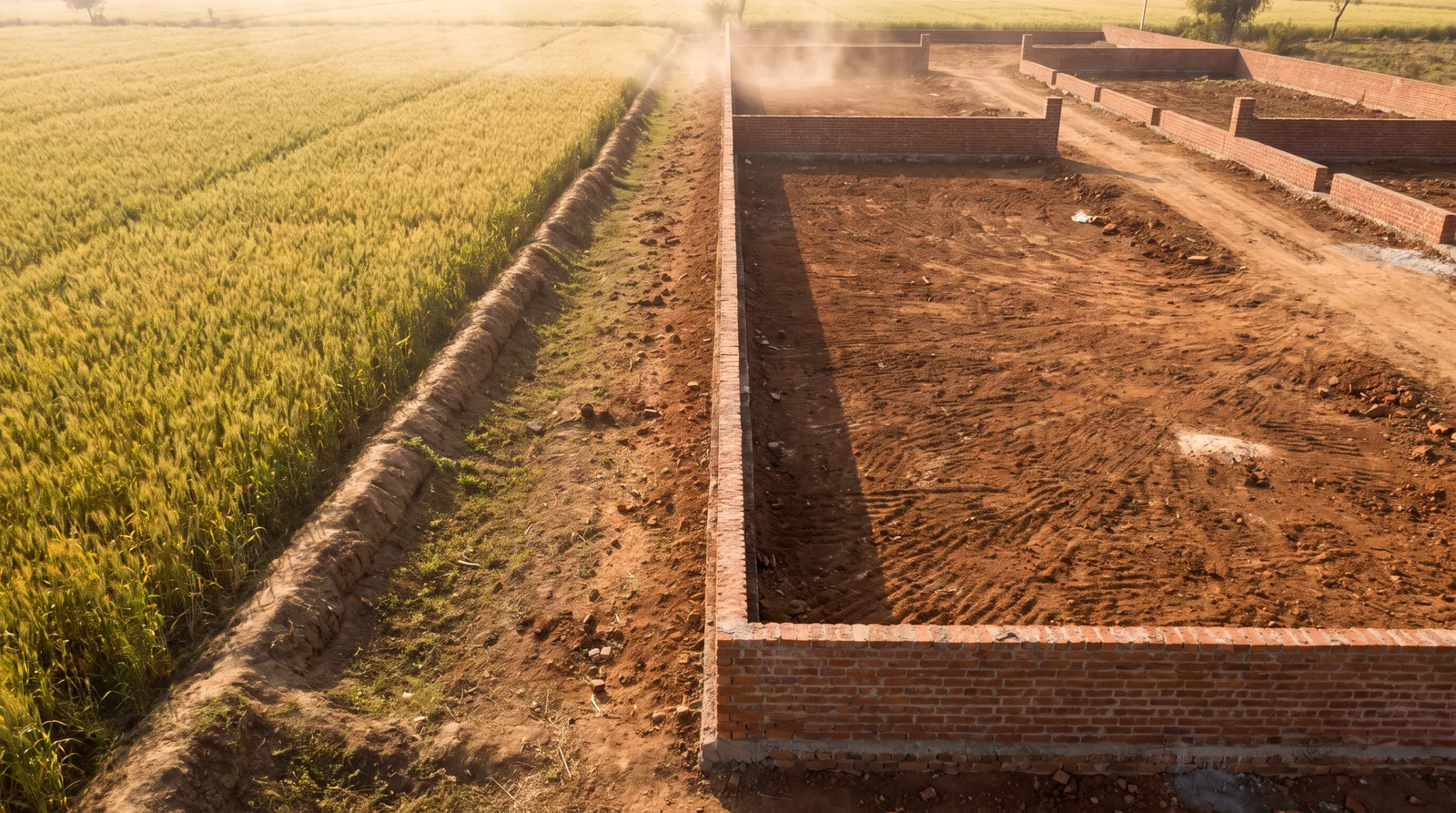
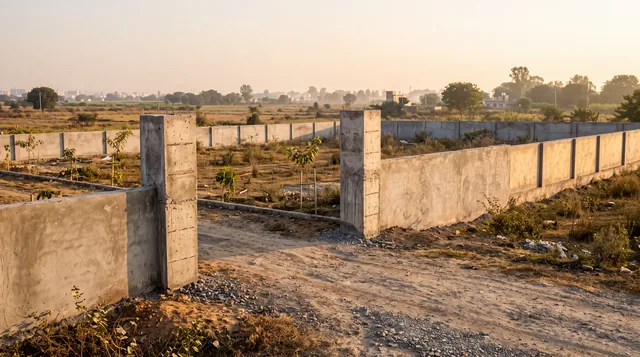
Drive past the ring of finished colonies and you will find plots that look ready: a gravel lane, a compound wall, a gate, a number painted on a pillar. Every one of those was put there by a person with a contractor. Not one of them is an entry in the revenue record, and the record is the only place where the land's status lives. To the state, a field with a wall around it is still a field.
This is not a theoretical worry. In August 2025 the district administration in Indore ordered sixteen more FIRs over 813 plots carved out without authorisation, together valued at more than ₹100 crore. Fifty-seven FIRs had already been filed by then, covering 11.665 hectares cut up into plots.
काग़ज़ पर वह आज भी खेत ही है।
Kaagaz par woh aaj bhi khet hi hai.

What diversion actually does
Under Section 59 of the Madhya Pradesh Land Revenue Code, 1959, land assessed for one purpose and put to another has its land revenue altered and reassessed for the new purpose, and a premium on the diversion becomes payable at the prescribed rates. The change runs from the date the diversion was made.
Read that narrowly, because it is narrow. It is a revenue provision, about what the parcel is assessed for and what is charged on it. It is not a planning provision. Nobody in the revenue office has looked at a drawing of the colony, and nobody has asked whether the lane in front of your plot is wide enough for a fire engine.
The paper changed in 2018
Which document you should ask for depends on when the parcel was diverted, because the procedure itself was rewritten.
| Until the 2018 amendment | Since the 2018 amendment | |
|---|---|---|
| The rule | Section 172 required prior permission | Section 172 omitted; prior permission no longer needed |
| Who decides | The landholder applied to the Sub-Divisional Officer, who could grant, grant with conditions, or refuse | The bhumiswami computes the premium and the reassessed revenue, deposits it, and sends the SDO written intimation with the receipt |
| The paper | A diversion order signed by the SDO | The intimation, the deposit receipt and the record entry that follows |
| From when | The date of the order | The date of the intimation; the land is deemed diverted from that day |
So for a parcel diverted in the last few years, an "order" is the wrong thing to ask for. The right thing is the intimation and its receipt. For an older parcel, it is the order.
Deemed is not the same as settled
The self-computed route does not take the SDO out of the picture. The officer still checks the landholder's arithmetic, and any shortfall is payable within sixty days. Where no intimation was ever given, the SDO may work out the amount owed and add a penalty of fifty per cent of the total. A seller who says the land "is diverted" but cannot produce the intimation and receipt may be describing a diversion that never happened, or one that carries an unpaid penalty.
Diversion intimation is a listed service on MP Bhulekh, the state's land-records portal, which also keeps agricultural land revenue and diverted land revenue apart when dues are paid. The parcel's status can be read there rather than taken on trust.
पहले आदेश मिलता था — अब सूचना दी जाती है।
Pehle aadesh milta tha — ab soochna di jaati hai.
One permission of three
Diversion is the first step and the smallest. Two others have to exist, from two different authorities, before a colony is a colony in anything but name.
| What it does | Who grants it | Under | |
|---|---|---|---|
| 1. Diversion | Changes the purpose the parcel is assessed for on the revenue record | Sub-Divisional Officer (revenue side) | MP Land Revenue Code, 1959, s.59 |
| 2. Development permission and layout | Once a development plan is in force, no one may change the use of land or carry out development without the Director's written permission | Town and Country Planning (planning side) | MP Nagar Tatha Gram Nivesh Adhiniyam, 1973, ss.26, 29 and 30 |
| 3. Permission to develop the colony | The developer must be a registered colonizer and must hold the local body's permission for that particular colony | Municipal corporation or council (local body) | MP Nagarpalika (Colony Development) Rules, 2021 |
The order they come in
This is a sequence, not a menu. A colonizer first registers with the local body, on application in the prescribed form; that registration runs for five years. The application to develop a particular colony then goes to the local body before any work starts, and it must carry the diversion fee receipt together with a no-objection certificate from Town and Country Planning. Only after permission to develop the colony has been granted can construction on the plots be permitted, under the MP Bhoomi Vikas Niyam, 2012.
Indore has tightened this locally. In June 2024 the Collector directed that development permission and the Town and Country Planning layout be recorded in the khasra itself, and that land under one acre not be registered as a plot.
क्रम गड़बड़ हुआ, तो प्लॉट वहीं अटक जाता है।
Kram gadbad hua, to plot wahin atak jaata hai.
What "it's diverted" tells you, and what it does not
It tells you that this parcel is now assessed for a non-agricultural purpose on the revenue record, and that land revenue on it is payable at the diverted rate. That is a real answer to a real question.
It does not tell you:
- that the colony is an approved colony;
- that a layout has been sanctioned, or that your plot number appears on it;
- that you may start building;
- that roads, drains, water or power were ever anybody's obligation;
- anything at all about who owns the land.
See which steps exist before you meet anyone
Every colony and project on the platform is drawn to its recorded boundary with its status, its sanctioned layout where one exists, and the documents on file — 1,161 colonies and projects and 13,352 documents as of September 2026. Which of the three permissions a colony can show is visible before a single phone call.
See it for yourself on the map — boundaries, plans and paperwork on one screen.
Check a colony's status and the papers on its file →Questions people ask
What does land diversion mean in Madhya Pradesh?
It is the change of a parcel's assessed purpose on the revenue record, from agricultural to residential, commercial or industrial, under Section 59 of the MP Land Revenue Code, 1959. Land revenue is reassessed and a premium is paid.
Is a diversion order still issued in MP?
Not for recent diversions. Since the 2018 amendment removed Section 172, the landholder computes and deposits the premium and sends the SDO a written intimation with the receipt; the land is deemed diverted from that date. Parcels diverted before the amendment carry an SDO's order.
Does diverted land mean I can build a house on it?
No. Diversion changes the revenue record only. Building permission comes last, after Town and Country Planning permission and the local body's permission to develop the colony.
How do I check if a plot is diverted?
Ask the seller for the diversion order or, for a recent diversion, the intimation and deposit receipt. Diversion intimation is a listed service on MP Bhulekh, and diverted land revenue shows separately there.
What happens if diversion was never intimated?
The SDO may compute the amount payable and add a penalty of fifty per cent of the total. A shortfall in a self-computed amount is payable within sixty days.
Where the facts come from. The facts and figures in this post come from verified government sources and verified RERA-registered brokers.
Indori Zameen is a private platform. It is not a government body and is not affiliated with one — always confirm a record with the concerned authority before you commit money.
Share this post
Related posts
 Buying guides7 min read
ज़मीन ख़रीदने से पहले
Buying guides7 min read
ज़मीन ख़रीदने से पहले
Five checks before you buy land in Indore, each with its red flag
Five two-minute checks on any plot in Indore — registration, khasra, zone, proposed roads, sanctioned plan — and the red flag hiding inside each one.
8 Sep 2025 Maps & plans7 min read
वादा अलग चीज़ है। नक्शा अलग।
Maps & plans7 min read
वादा अलग चीज़ है। नक्शा अलग।
Promised vs sanctioned: the brochure and the layout plan
Why a brochure binds nobody and a sanctioned layout does, what reserved land looks like on the sheet, and the one question to ask when the amenity is not on it.
8 Sep 2025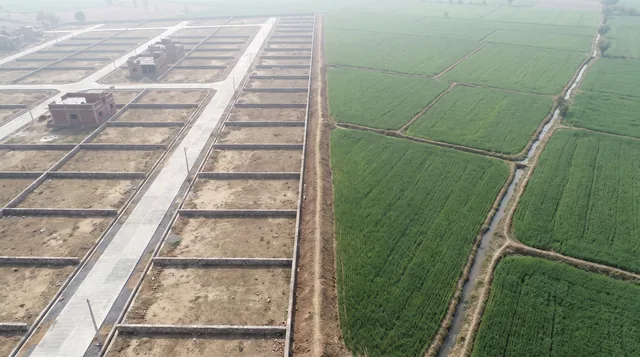 Indore8 min read
नगर निगम के अंदर या बाहर?
Indore8 min read
नगर निगम के अंदर या बाहर?
Inside or outside municipal limits: gram panchayat or IMC
Inside IMC or in a gram panchayat: who sanctions the colony, who lets you build, who owns the pipe and who sends the bill, and how to find out before you pay.
8 Sep 2025 Papers & law8 min read
काग़ज़ों के शब्द
Papers & law8 min read
काग़ज़ों के शब्द
Seven words on your papers: khasra, khatauni, diversion, FAR, mutation and more
Khasra, khatauni, diversion, layout sanction, guideline rate, FAR and setback, mutation: what each word on your plot's papers means, and why it matters.
8 Sep 2025Tagged diversion, gram-panchayat, instagram-series, t-and-cp, layout-plan.
Read it. Then check it on the map.
Every colony's boundary, its approved layout, its zoning and its paperwork — on one screen. Signing in is free.