
फ़्लैट पर GST — कब लगेगा, कब नहीं?
GST on a flat: under construction versus ready
The one date that decides whether a flat from a builder carries GST, the two rates that apply, and five questions to put to the next demand letter.

On this page
GST on a flat bought from a builder turns on one date: the completion certificate, or first occupation if that comes earlier. If any part of the price is paid before it, GST applies, at 5% of the total price, or 1% for an "affordable" flat. If every rupee is paid after it, there is no GST.
The date decides
The same flat, at the same price, can carry a tax bill or none, depending on when you paid for it. The Central GST Act treats construction of a building meant for sale as a supply of a service, except where the entire consideration is received after the completion certificate is issued, or after first occupation, whichever is earlier.
Read that exception closely. It needs the entire price to come after the certificate. A booking amount paid while the building is still going up is enough to bring the sale inside GST.
| When the money is paid | What the law treats it as | GST |
|---|---|---|
| Any part before the completion certificate or first occupation | A supply of construction | 5% or 1% |
| Every rupee after it | A sale of a finished building | None |
तारीख़ बदली, तो टैक्स बदल गया।
Taareekh badli, to tax badal gaya.
The two rates, and what "without input credit" means
For a residential flat being built by a promoter, the notification sets two effective rates.
| Flat | GST on the total price |
|---|---|
| "Affordable" (both tests below pass) | 1% |
| Any other residential flat | 5% |
Neither rate comes with input tax credit: the builder cannot set the GST it paid on cement, steel and services against the GST it collects from you.
These rates apply to projects begun on or after 1 April 2019, and to older ones whose builder did not choose to stay on the earlier rates. The general GST rate changes that took effect on 22 September 2025 left them untouched: the September 2025 amendment to this part of the notification changed other items only.
Why the notification says 7.5% but the bill says 5%
GST does not reach land. The price of a flat, though, includes your share of the land under it. Rather than ask what that share really cost, the rule deems the land to be one-third of the total amount charged and taxes only the remaining two-thirds.
So the rate in the notification is applied to two-thirds of your price:
- Any other flat: 7.5% × ⅔ = 5% of the price (3.75% central tax and 3.75% state tax, on two-thirds).
- "Affordable" flat: 1.5% × ⅔ = 1% of the price (0.75% central and 0.75% state, on two-thirds).
The "total amount" is everything charged for the construction plus the land or your undivided share of it. A demand letter may show "5% of the price" or "7.5% of two-thirds"; they are the same number.
1% or 5%: two tests, both required
"Affordable" here is a definition in the notification, not a word from an advertisement.
- Carpet area up to 90 square metres, about 969 square feet, in Indore. The limit is 60 square metres only in the metropolitan areas the notification names: Bengaluru, Chennai, Delhi NCR, Hyderabad, Kolkata and Mumbai. Indore is not on that list. Carpet area here means carpet area as RERA defines it, explained in our guide to carpet, built-up and super built-up area.
- Gross amount up to ₹45 lakh, counting everything charged for the flat: the price, the land share, and extras such as preferential location, development, parking and common-facility charges.
Both pass: 1%. Either fails: 5%.
Worked through, with invented numbers
One ₹60 lakh flat, bought on two timelines. Every figure is made up for the illustration.
| Booked while being built | Bought after the certificate | |
|---|---|---|
| Total amount charged | ₹60,00,000 | ₹60,00,000 |
| Deemed land, one-third | ₹20,00,000 | — |
| Value GST is worked on | ₹40,00,000 | — |
| GST at 7.5% of that | ₹3,00,000 | Nil |
| Paid to the builder | ₹63,00,000 | ₹60,00,000 |
And an "affordable" flat: ₹36 lakh, 85 square metres of carpet, in Indore, booked while being built. Two-thirds is ₹24 lakh; 1.5% of that is ₹36,000, which is 1% of the price.
Stamp duty and the registration fee are a separate state levy on the sale deed, paid at the registry in both columns.
Three purchases with no GST at all

- A finished flat paid for after the certificate. Every rupee after completion or first occupation.
- A resale from the owner. A completed flat sold on by the person who owns it is a sale of a building, which the Act keeps outside GST.
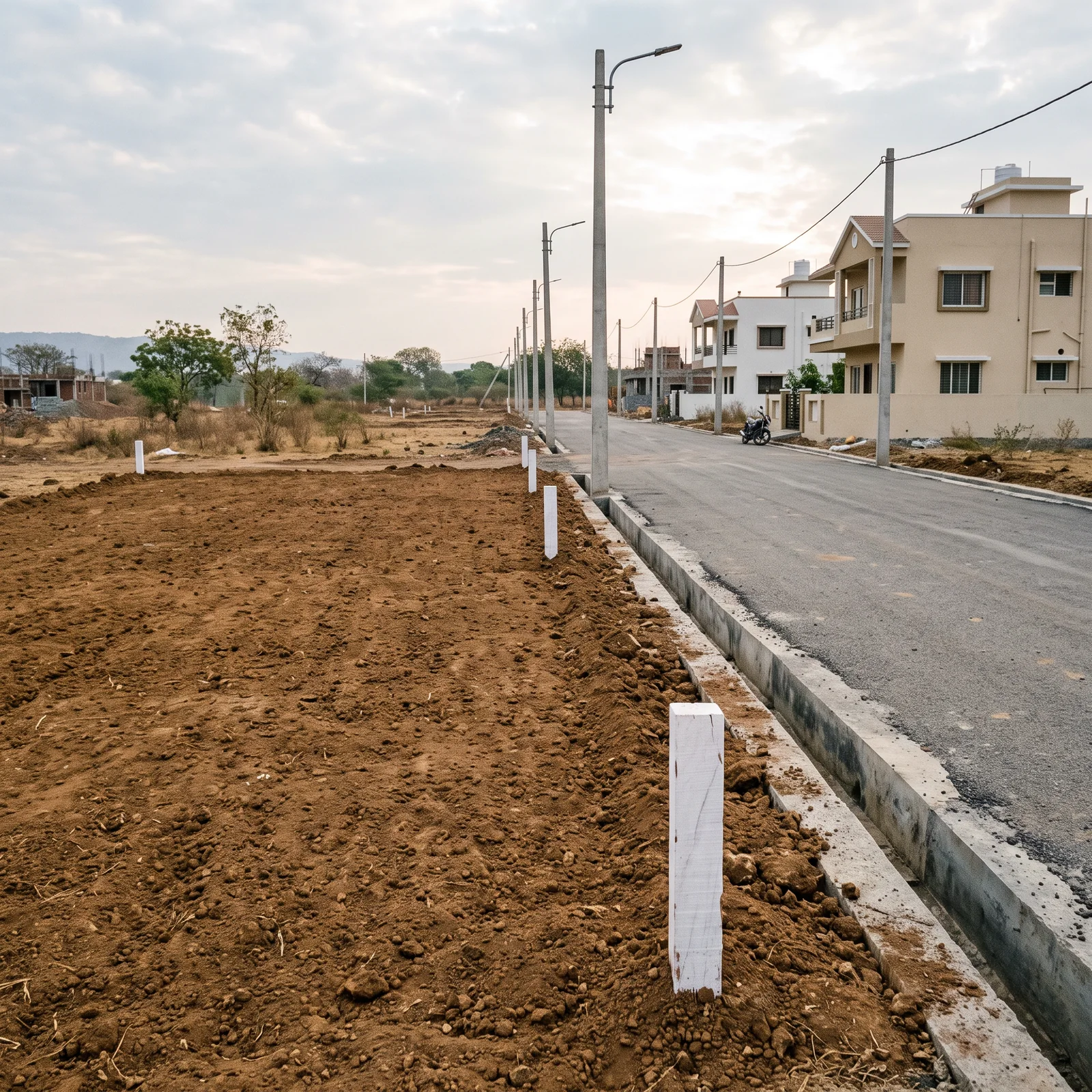
- Land. It stays a sale of land even after levelling or laying drainage, water or power lines.
One caution on plots. Development work supplied as a separate service, such as levelling or laying drains, is taxed at its own rate. If a plot's price is split into "land" and "development charges", ask a chartered accountant how the second line is taxed.
Five questions before the next instalment
- Has the completion certificate been issued, and when? That date settles whether there is any GST to pay; our guide to occupancy and completion certificates explains the paper.
- Was any of my money paid before that date? Even the booking amount is enough.
- Is GST shown on its own line, and at what rate? Expect 5% or 1% of the price, which may be written as 7.5% or 1.5% of two-thirds.
- Why is this flat taxed at that rate? Get its carpet area and gross amount from the builder in writing.
- What is the project's MP RERA registration number? Look the record up yourself rather than taking a printout.
पैसा देने से पहले, डिमांड लेटर की GST वाली लाइन पढ़िए।
Paisa dene se pehle, demand letter ki GST waali line padhiye.
See it for yourself on the map — boundaries, plans and paperwork on one screen.
Look up the project's colony, layout and zone before you read the invoice →Questions people ask
Is GST applicable on ready to move flats?
Not if the entire price is paid after the completion certificate is issued or after first occupation, whichever is earlier. If any amount, even a booking amount, was paid before that date, GST applies.
What is the GST rate on under construction flats in 2026?
5% of the total price for a residential flat, or 1% for an affordable one, both without input tax credit. The rates were unchanged by the rate revision of 22 September 2025 and are current as of October 2026.
What is an affordable flat for GST in Indore?
One with a carpet area up to 90 square metres and a gross amount up to ₹45 lakh. Both tests must pass. The 60 square metre limit applies only in six named metropolitan areas, and Indore is not one of them.
Why is GST 5% when the notification says 7.5%?
One-third of the price is treated as land, and land is outside GST. 7.5% on the remaining two-thirds equals 5% of the whole price.
Where the facts come from. The facts and figures in this post come from verified government sources and verified RERA-registered brokers.
Indori Zameen is a private platform. It is not a government body and is not affiliated with one — always confirm a record with the concerned authority before you commit money.
Share this post
Related posts
 Buying guides7 min read
बन रहा है, या बन चुका है?
Buying guides7 min read
बन रहा है, या बन चुका है?
Under construction or ready to move: two different products
An under-construction flat is not a discounted ready one. It is a different purchase with a different risk. What to settle before you book either.
3 Oct 2026 Papers & law8 min read
CC और OC — बिना इनके क़ब्ज़ा मत लीजिए।
Papers & law8 min read
CC और OC — बिना इनके क़ब्ज़ा मत लीजिए।
Occupancy certificate and completion certificate: two papers, two jobs
A completion certificate says the building matches its plan. An occupancy certificate says you may live in it. Ask for both before you take the keys.
3 Oct 2026 Buying guides7 min read
आप किस एरिया का पैसा दे रहे हैं?
Buying guides7 min read
आप किस एरिया का पैसा दे रहे हैं?
Carpet area, built-up area, super built-up area: only one is defined by law
Three areas, one flat, and you are usually quoted the biggest. What carpet area means in law, and how to work out your real price per usable square foot.
3 Oct 2026 Money8 min read
रेट एक, क़ीमत कई। पूरी शीट पढ़िए।
Money8 min read
रेट एक, क़ीमत कई। पूरी शीट पढ़िए।
The price sheet: reading a builder's cost sheet line by line
The rate you were quoted is one line of a builder's cost sheet. What the other lines are, which are already in the price, and what to ask before a token.
3 Oct 2026Tagged flat, developer, instagram-series, checklist, rera.
Read it. Then check it on the map.
Every colony's boundary, its approved layout, its zoning and its paperwork — on one screen. Signing in is free.