
ब्रोशर नहीं, शहर पढ़िए।
Read the city, not the brochure: judging a location yourself
Five things you can read about any location in Indore from a screen, before you take anybody's word for what it is going to become.
On this page
You judge a location in Indore by reading five things the seller did not write: the zone the master plan gives the land, which roads exist and which are only proposed, the minutes to your own landmark, what surrounds the plot, and whether the colony is on the register at all. Each one is a screen, not a phone call.
A promise and a decision are different things
A brochure describes what is coming. It is written by the person selling, and nobody has to approve a word of it. The city's development plan and the colony register describe what has already been decided. They are written by the authority, and they are on the record whether or not anybody is selling anything this week.
That is the whole method. Whenever somebody tells you what a location is going to be, go and read what it already is. The five reads below go in the order you would naturally ask them, and every one of them is available before you leave the house.
वादा अलग चीज़ है, फ़ैसला अलग।
Vaada alag cheez hai, faisla alag.
Read 1: the zone, not the promise
The master plan assigns every piece of land in the planning area a use: residential, commercial, industrial, public and semi-public, green belt, and so on. That one line decides what may lawfully be built there, and it is the one line the seller does not get to write. A plot described as "residential" in conversation and shown as agricultural or green on the plan is not a residential plot yet, whatever the hoarding says.
Look the location up on the Master Plan Portal, read the zone beside it, and read the zone of the land around it while you are there.
Read 2: the roads, and which ones exist
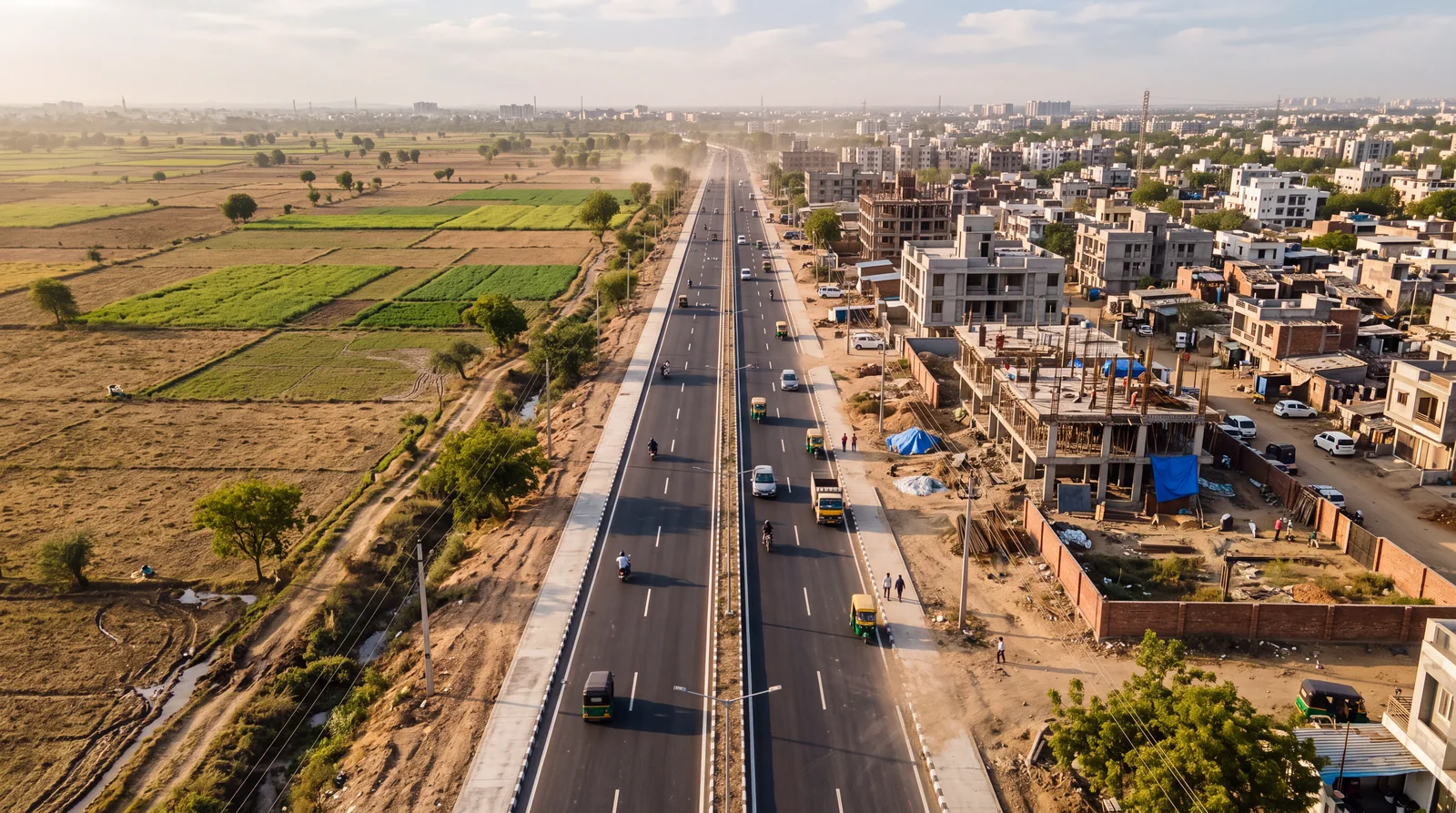
A development plan draws two kinds of road, and they are worth very different amounts. A built road is one you can drive down today; it is already doing its job of carrying people and raising the value of the land beside it. A proposed road is a line on a drawing. It may arrive in five years, in twenty, or not at all — and it may arrive straight through the plot you are being shown.
So when a location is sold to you as "on the new ring road" or "next to the proposed bypass", ask which of the two you are looking at, and find the line on the plan yourself.
Read 3: measure your own life against it
The usual way round is that you are shown a plot and then told how close everything is to it: the school, the hospital, the office park. The honest way round starts from your side. Pick the landmark your life actually turns on — the place you go every morning — and ask which colonies fall within reach of it.
On the map you can drop that landmark and see the registered colonies inside a one-, five- and ten-kilometre ring around it. Kilometres are a number; minutes are a life. A plot ten kilometres from the office on a road that exists may be a shorter day than one five kilometres away on a road that does not.
रोज़ का सफ़र ही आखिरी सच है।
Roz ka safar hi aakhri sach hai.
Read 4: what is around it
You buy the neighbourhood along with the plot. Zoom out one step from the colony and read the land that touches it: which village it sits in, what is already built next door, what the neighbouring land is zoned for, and whether the open field beside it is open land or a plot on somebody else's layout.
The zone next door becomes your view, your traffic and your air. A residential plot with an industrial zone on its boundary is a different purchase from one with a green belt there, at the same price per square foot.
Read 5: the register, not the hoarding
A board on the roadside is not a status. Anyone can put one up, and many of them stand over land that has no colony behind them at all. The register is the opposite: a list the authority keeps, with a record beside each name.
So the last read is the simplest. Is the colony on the register at all? And if it is, what does the record say beside its name — approved, in process, or something else? As of September 2026 the map carries 1,161 colonies and projects drawn to their recorded boundaries, with 13,352 documents behind them.
The routine, in order
| Read | The question | Where |
|---|---|---|
| 1 | What is the land zoned for? | Master Plan Portal |
| 2 | Which roads exist, and which are only proposed? | Master Plan Portal |
| 3 | How many minutes from my own landmark? | Map, with distance rings |
| 4 | What is built and zoned next door? | Map, one step zoomed out |
| 5 | Is the colony on the register, and what does it say? | The colony's public page |
None of these needs a favour, a phone call or somebody's cousin in an office. Anyone can describe a location to you. With these five, you can read it.
Where to check
See it for yourself on the map — boundaries, plans and paperwork on one screen.
Drop your own landmark and see which registered colonies sit inside 1, 5 and 10 km of it →Questions people ask
How do I check what a plot in Indore is zoned for?
Look the location up on the Master Plan Portal; the zone the notified development plan gives that land is shown beside it. Read the neighbouring zones too.
Is a proposed road on the master plan a good sign for a plot?
Sometimes, but it is a line on a drawing, not a road, and it can cross the plot itself. Check the alignment and treat only built roads as certain.
How far should a plot be from my office?
Measure in minutes along roads that exist, not kilometres in a straight line. Use the distance rings on the map from your own landmark and then drive it at the time you would actually travel.
Does a hoarding on the site mean the colony is approved?
No. A hoarding is an advertisement anyone can put up. Approval is a matter of record: check whether the colony is on the register and what its status says.
Can I judge a location without visiting it?
You can do the five reads from a screen before you go — zone, roads, distance, neighbours, register — and use the visit to confirm what you read rather than to hear it for the first time.
Where the facts come from. The facts and figures in this post come from verified government sources and verified RERA-registered brokers.
Indori Zameen is a private platform. It is not a government body and is not affiliated with one — always confirm a record with the concerned authority before you commit money.
Share this post
Related posts
 Maps & plans7 min read
मास्टर प्लान पोर्टल कैसे इस्तेमाल करें।
Maps & plans7 min read
मास्टर प्लान पोर्टल कैसे इस्तेमाल करें।
How to use the Master Plan Portal, in five steps
Find your land on the development plan, read its zone off the colour, spot roads not yet built, find the building rules, and lay your colony on top.
8 Sep 2025 Indore7 min read
इंदौर का नक्शा बदल रहा है।
Indore7 min read
इंदौर का नक्शा बदल रहा है।
Indore is being redrawn: Master Plan 2035, the metro and the metropolitan region
A new master plan, a metro ring partly open, and a law that plans Indore as a region: what each changes for a plot, and where to check your own land.
8 Sep 2025 Buying guides8 min read
ज़मीन पर जाकर क्या देखें।
Buying guides8 min read
ज़मीन पर जाकर क्या देखें।
The plot site visit: what to check with your feet
Walk all four sides, pace the road, return at another hour, look down and up, ask the neighbours, photograph the markers with the date on. The site visit list.
8 Sep 2025 Buying guides8 min read
इश्तिहार की भाषा
Buying guides8 min read
इश्तिहार की भाषा
Decoding the advertisement: seven phrases and the question each one hides
Prime location, approved, clear title, loan available — what each pamphlet phrase can honestly mean, and the one question that puts it on paper.
8 Sep 2025Tagged site-visit, master-plan, instagram-series, how-to, platform, checklist.
Read it. Then check it on the map.
Every colony's boundary, its approved layout, its zoning and its paperwork — on one screen. Signing in is free.