
बँटवारा — खेत बँटें, रिश्ते नहीं।
Batwara: dividing family farmland through the Tahsildar in Madhya Pradesh
Why a joint holding should be divided while the family agrees, the two routes the MP Land Revenue Code offers, what the Patwari's fard batwara is, and what a buyer of someone's 'share' must ask to see.

On this page
In Madhya Pradesh, family farmland held jointly is divided by the Tahsildar under the Land Revenue Code: either a co-owner applies to partition his share (section 178), or the holder divides his land among his heirs in his lifetime (section 178-A). The Patwari's fard batwara shows who gets which part. Until that order is recorded, nobody owns a particular field.
Why a joint holding causes trouble
When a landholder dies, his interest in the land passes to his heirs under their personal law. The record then shows the whole holding against every heir's name, and it says nothing about which field belongs to whom. A generation later, each of those heirs has heirs of their own, and the list of names on one holding grows longer.
Nothing in that is wrong while the family agrees. The trouble arrives later: one branch wants to sell, another wants to build, a third lives abroad and cannot be reached, and every one of them is a necessary party to any decision about any part of the land.
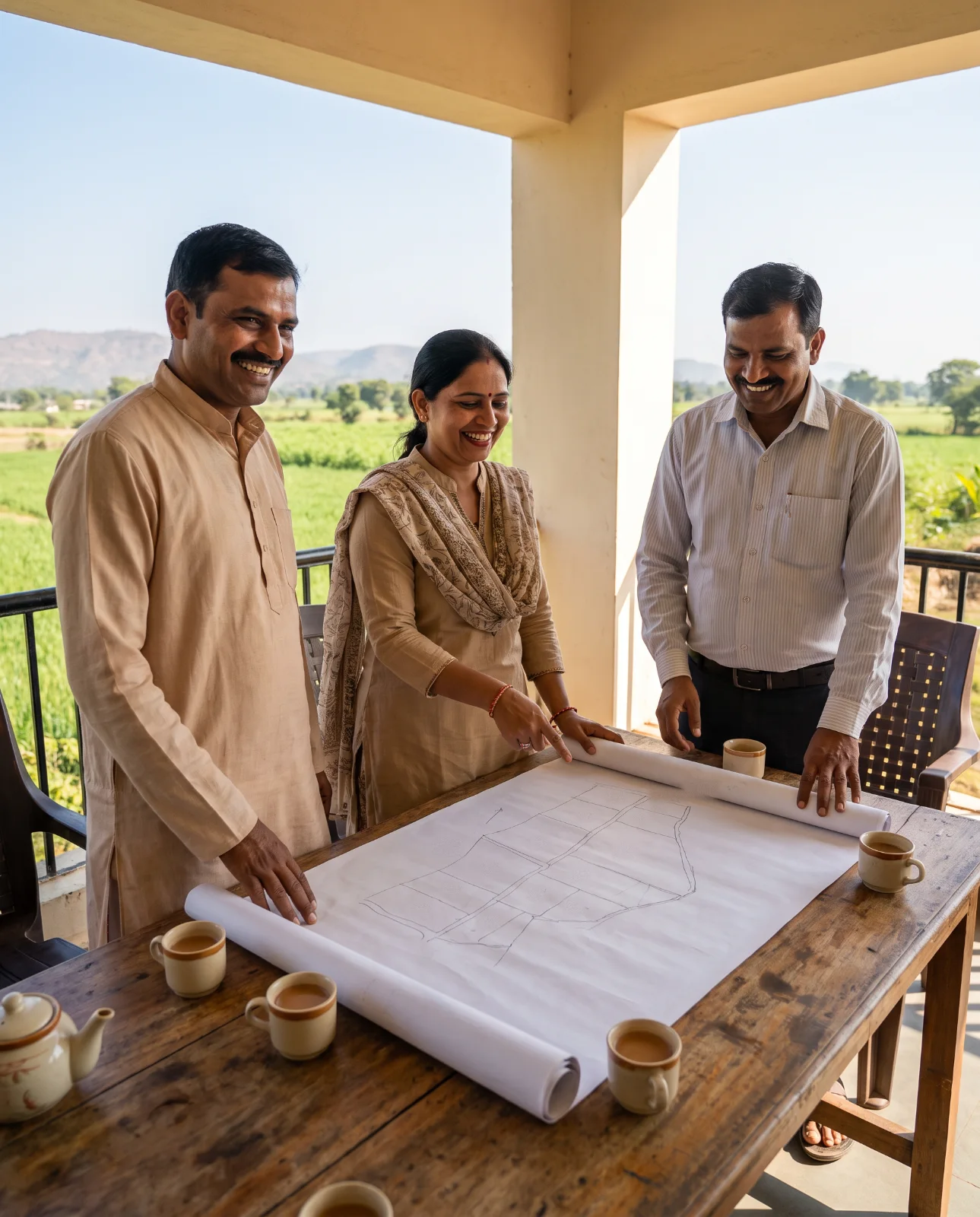
Agreement is the short road
When no one contests ownership, the Tahsildar splits the holding by what the record of rights already says. It is an administrative process, and it moves quickly when every co-sharer is on the same page.
A dispute pauses it
If anyone raises a question of title, the Tahsildar stays the case for three months so that a civil suit can be filed. If the civil court then grants a stay, the partition waits until the suit is decided. That can mean years. It is the strongest reason to divide while the family still agrees.
बँटवारा भाइयों के बीच दीवार नहीं, रिकॉर्ड में लकीर है।
Batwara bhaiyon ke beech deewaar nahin, record mein lakeer hai.
Two routes, both at the Tahsildar
| Section 178 | Section 178-A | |
|---|---|---|
| Who applies | Any one bhumiswami of a holding with more than one | The bhumiswami himself |
| For what | His own share, carved out of a holding assessed for agriculture | His agricultural holding, or part of it, divided among his legal heirs |
| Who is heard first | The other co-owners | His legal heirs |
| The result | The holding divided, and its land revenue apportioned between the parts | The same |
These routes serve farmland only. Splitting a house, or a plot already diverted to another use, takes a partition deed among the owners or a civil suit, and any such deed dividing immovable property has to be registered.
Section 178-A: dividing in your own lifetime
A bhumiswami may, during his life, ask the Tahsildar to divide all or part of his agricultural holding between his legal heirs. The heirs are heard before the order is made. It lets the person who kept the land decide how it is shared, with everyone present, instead of leaving the question to be argued over later.
The application is the holder's alone. The Indore bench of the High Court ruled in September 2026 that a son has no standing under this section to partition land still recorded in his father's name.

The fard batwara: who gets which field
Between the application and the order sits the Patwari's partition statement, the fard batwara. It sets out how the holding will be divided: which part, of what area, goes to which co-sharer. Take a joint holding of 3.00 hectares in the names of A, B and C. After the order, the record might show A with 1.10 hectares, B with 0.95 and C with 0.95, each part identified on the ground.
The process runs in five steps:
- Application to the Tahsildar.
- Notice to every co-sharer.
- The fard batwara, prepared by the Patwari.
- Hearing, where objections are heard.
- The order, and the land record corrected to show the divided holdings.
After the order come the boundary stones on the ground, so the line in the record is also a line in the field.
If you are offered "my share"
Here is where many buyers are caught. Until a partition is recorded, a co-owner holds a fraction of the whole holding, not a particular strip of it. There is nothing you can fence.
The Supreme Court said as much in 2024: one co-owner, whose share is not yet marked out, has no power to sell the whole property, and the buyer acquires only what that co-owner actually held.

Before any token, ask for three things:
- The partition order: the Tahsildar's order dividing the holding, with the fard batwara behind it.
- The record after it: today's khasra and B-1, with the divided part standing in the seller's name and nobody else's.
- The part on the map: which piece of the field it is, so that what you walk on is what you are buying.
What this guide does not cover
Why every heir has to sign when inherited land is sold is in inherited property. How to pull the khasra and B-1 is in check your land record yourself, and how boundary disputes begin is in boundary disputes. This is general information, not legal advice; a partition is decided on your own record, so take a lawyer's view on your family's case.
See it for yourself on the map — boundaries, plans and paperwork on one screen.
See your village, the colonies around it and its master-plan zone →Questions people ask
How is agricultural land partitioned in MP?
Through the Tahsildar under the MP Land Revenue Code. A co-owner applies to partition his own share under section 178, or the holder applies under section 178-A to divide his land among his heirs in his lifetime. Co-sharers get notice, the Patwari prepares a fard batwara, objections are heard, and the record is corrected after the order.
What is fard batwara?
The Patwari's partition statement. It sits between the application and the order and sets out how the holding will be divided: which part, of what area, goes to which co-sharer. The High Court has let stand the cancellation of a partition whose fard was never published or signed, so co-sharers should read and sign it.
Who does the zameen ka batwara in MP?
The Tahsildar, under the Land Revenue Code, for land held for agriculture. When no one contests ownership, the holding is split by what the record of rights already says, and it moves quickly when every co-sharer agrees. Splitting a house or diverted plot instead needs a registered partition deed or a civil suit.
What happens if a family member objects to the batwara?
If anyone raises a question of title, the Tahsildar stays the case for three months so that a civil suit can be filed. If the civil court then grants a stay, the partition waits until the suit is decided, which can mean years. That is the strongest reason to divide while the family still agrees.
Can I buy a share of joint family agricultural land?
You can buy only what the seller owns, which before partition is a fraction of the whole holding, not a field you can fence. The Supreme Court said in 2024 that a co-owner cannot sell the whole. Before any token, ask for the partition order, today's khasra and B-1 in the seller's name, and the part on the map.
Can a son apply for partition of his father's land in MP?
Not under section 178-A while the land is still recorded in the father's name. That section lets the bhumiswami himself divide his holding among his heirs during his life, and in September 2026 the Indore bench of the High Court held that a son has no standing to apply under it.
Sources
- M.P. Land Revenue Code, 1959, ss.164, 178(1), (1-A), (2) and 178-A
- M.P. Bhu-Rajasva Sanhita (Krishi Khate ka Vibhajan) Niyam, 2020 (23 September 2020)
- MP High Court — MP 2922/2019 (10 December 2019); MP 158/2020 (5 February 2020); WP 12779/2024 (13 May 2025); WP 10515/2024, Indore bench (8 September 2026)
- Supreme Court of India — Civil Appeal No. 4177 of 2024 (September 2024)
- Registration Act, 1908, s.17(1)(b)
Where the facts come from. The facts and figures in this post are drawn from public government records and from practising Indore brokers; confirm any record with the concerned authority.
Indori Zameen is a private platform. It is not a government body and is not affiliated with one — always confirm a record with the concerned authority before you commit money.
More on this topic: Family property and inheritance
Searches this guide answers
Share this post
Related posts
 Papers & law8 min read
एक वारिस छूट गया, तो सौदा अधूरा है।
Inherited property: why every legal heir has to sign the sale
Buy inherited land from four heirs out of six and you own four-sixths, not the plot. Who counts as an heir, and the papers that settle every share.
3 Oct 2026 Papers & law8 min read
अपना खसरा ख़ुद निकालिए।
MP Bhulekh: pull your own khasra and B1 in three steps
Your khasra and B-1 are public and searchable on the state's own portal, no sign-in needed to view. The right address, the search, and how to read it.
3 Oct 2026 Papers & law8 min read
सरहद का झगड़ा।
Plot boundary disputes with a neighbour: how they start, and how to avoid them
Boundary disputes begin as a few feet nobody measured. The six ways a line goes wrong, and the five cheap things to do before you build.
8 Sep 2026 Papers & law9 min read
गिफ़्ट, वसीयत, या बैनामा?
Gift deed, will or sale deed: moving property inside a family
A gift deed works today, a will on death, a sale deed only with real payment. How to choose between them, and the three family mistakes to avoid.
3 Oct 2026Tagged khasra, mutation, gram-panchayat, checklist, sale-deed, instagram-series.
Read it. Then check it on the map.
Every colony's boundary, its layout plan on record, its zoning and its paperwork — on one screen. Signing in is free.