
छत का पानी नाली में नहीं, ज़मीन में जाए।
Rooftop rainwater harvesting for a house in Indore: the rule, the litres, the system
How much water one roof collects in an Indore monsoon, why the district's groundwater needs it, when MP's building rules make a system compulsory, and how a simple one is built and kept working.

On this page
In a normal year, a 100 square metre roof in Indore collects about 78,000 litres of rain. Madhya Pradesh's building rules require a rainwater harvesting system on any building whose plot is larger than 140 square metres. A simple system filters the roof water and sends it into a recharge pit, an existing borewell or a storage tank.
How much water one roof collects
The arithmetic is simple enough to do on a phone. One millimetre of rain falling on one square metre of roof is one litre of water. Multiply the year's rainfall by the roof area, then by the share of the rain a roof actually yields, which for a typical roof is taken as 0.8.
For Indore district, where the normal annual rainfall is 976.8 millimetres:
976.8 mm × 100 sq m × 0.8 = 78,144 litres
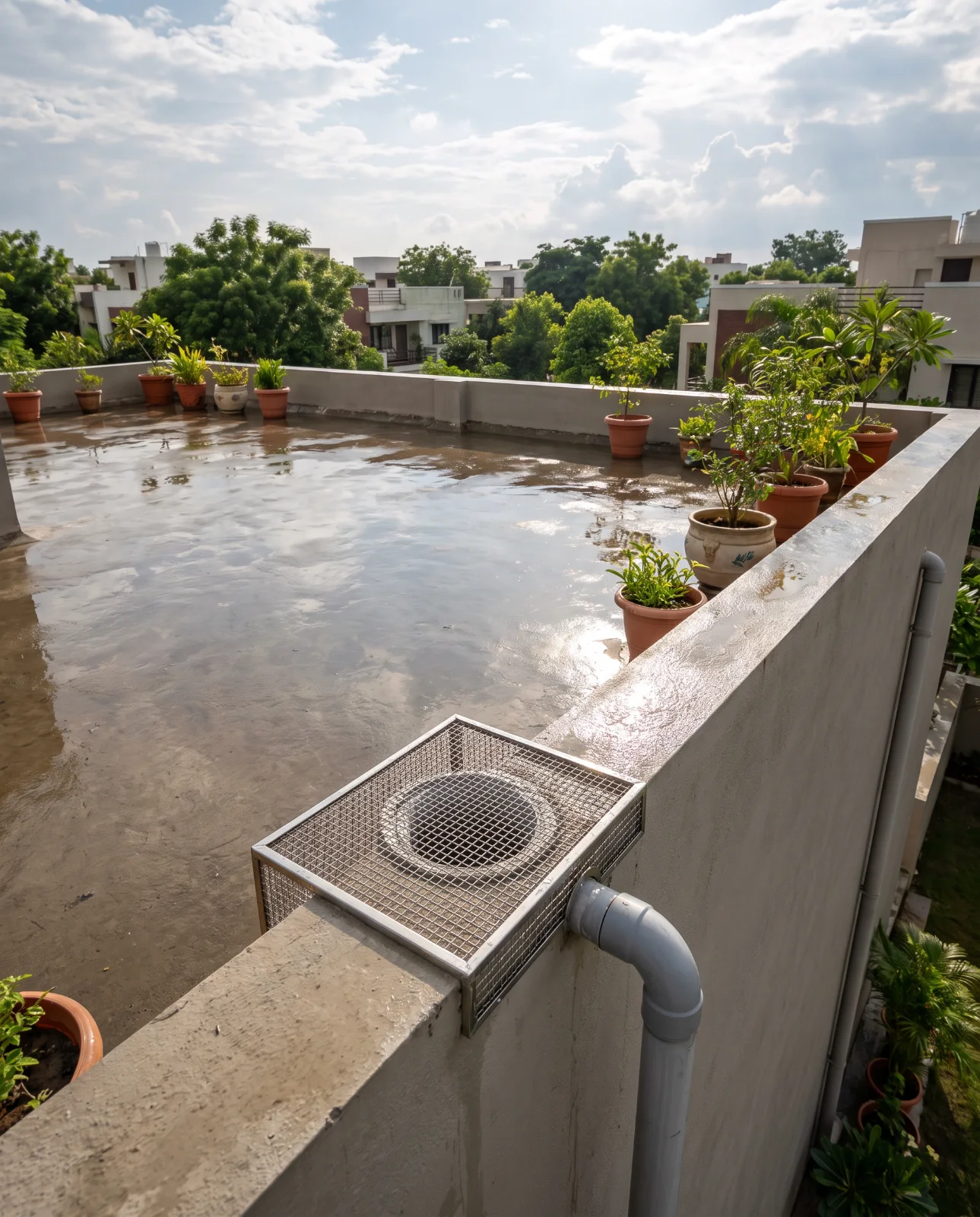
That is enough to fill a 1,000-litre overhead tank seventy-eight times. On a 100 square metre roof, about 1,076 square feet, it is the amount that currently runs down the downpipe, across the yard and into the street drain every monsoon.
Why it matters in Indore
The Central Ground Water Board assesses every district in units and places each in a band by its stage of extraction: the water drawn in a year, as a share of the water that can safely be drawn.
| Band | Stage of extraction |
|---|---|
| Safe | Up to 70 per cent |
| Semi-critical | 70 to 90 per cent |
| Critical | 90 to 100 per cent |
| Over-exploited | Above 100 per cent |
In the 2024 assessment, none of Indore district's five units was in the safe band. Depalpur, Indore and Sanwer were over-exploited, Indore Urban was critical and Mhow semi-critical. Across the district the stage of extraction was 118.84 per cent: about 119 litres are pumped for every 100 the aquifer can safely spare each year.
जितना निकालते हैं, उतना लौटाना भी सीखिए।
Jitna nikaalte hain, utna lautaana bhi seekhiye.
When the rules make it compulsory
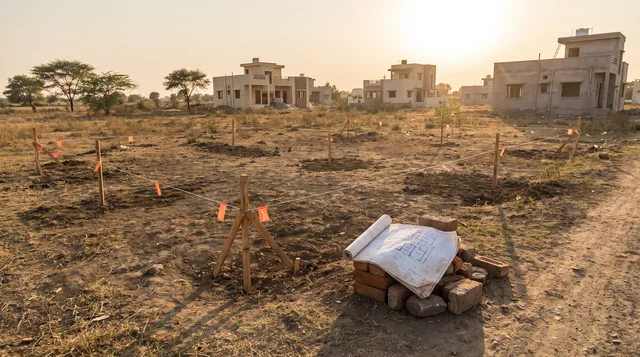
Rule 81(4) of the MP Bhumi Vikas Rules, 2012 requires a rain or roof water harvesting arrangement on every type of building whose plot is more than 140 square metres, about 1,507 square feet. These are the rules a building permission in Indore is checked against, so the system should be on the drawing from the start.
| Plot | Area | Rule 81(4) |
|---|---|---|
| 30 × 50 ft | 139.4 sq m | Just under the line |
| 30 × 60 ft | 167.2 sq m | Applies |
| 40 × 60 ft | 223.0 sq m | Applies |
A colony layout of two hectares or more must also show rainwater harvesting measures. And a house just under the line loses nothing by having a system anyway.
How a simple system works
The Central Ground Water Board describes a system in four parts.
- The roof and a mesh. A mesh where the roof drains keeps leaves and debris out. It should not be too fine, or the roof will hold water.
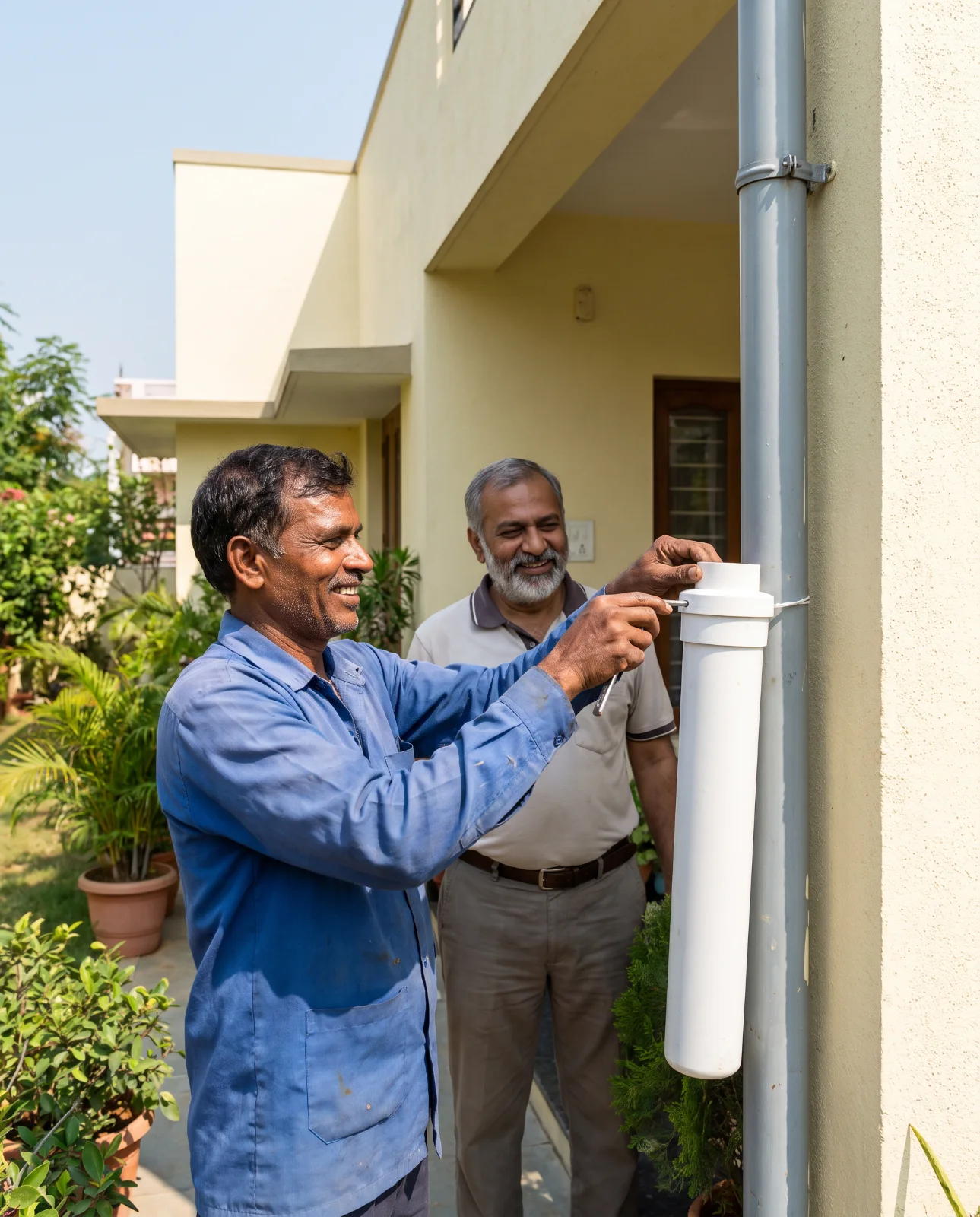
- The first flush. A valve diverts the first spell of each rain, which carries the roof's dust, away from the filter.
- The filter. Layers of pebbles at the bottom, gravel above, sand on top. A filter of about 2 × 1 × 1 metres serves a 100 square metre roof.
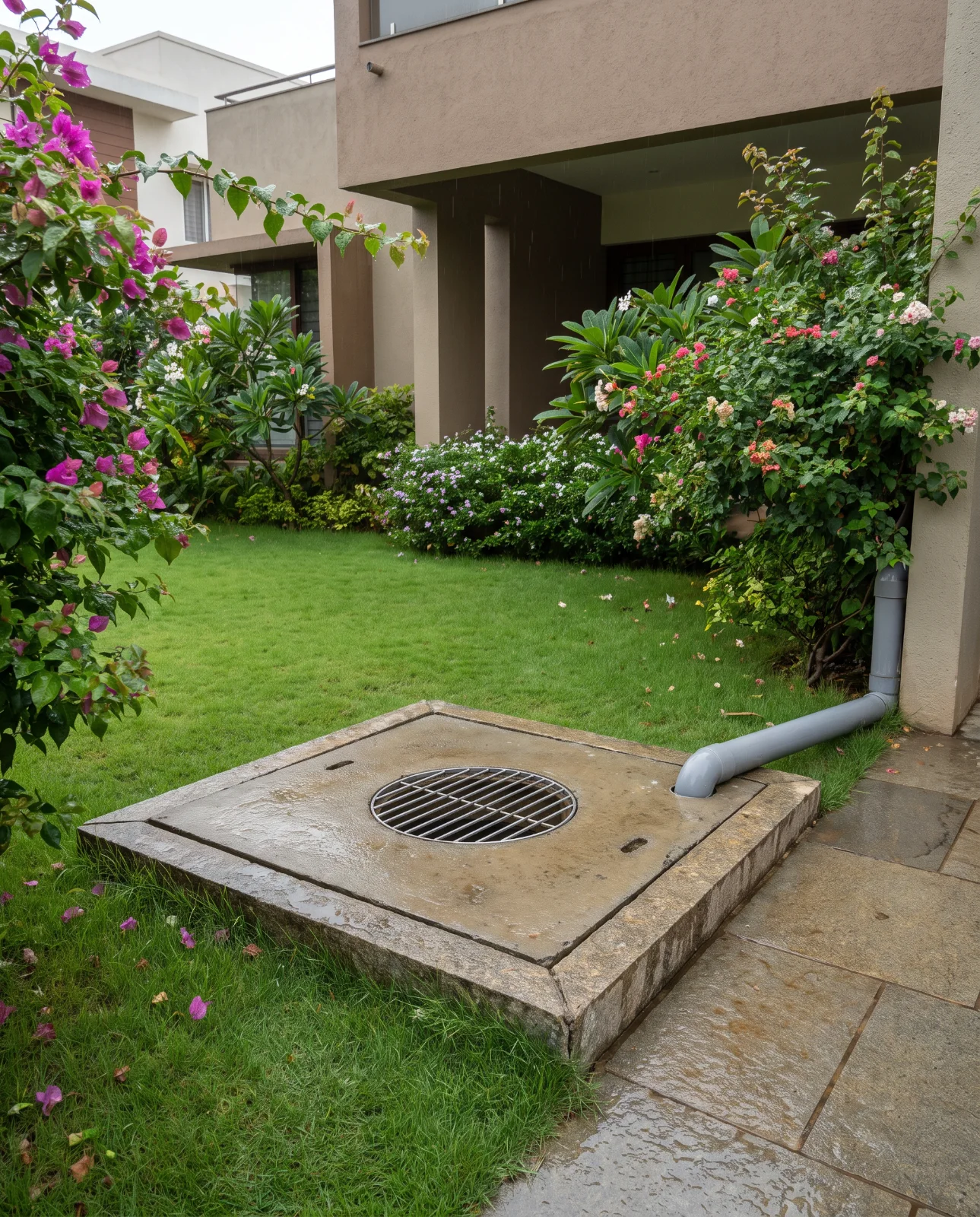
- Where the water goes. Down a recharge pit that has its own filter bed, down a borewell already on the plot, or into a tank to be used.
Asbestos roofs are not suitable for collection, the same guide notes.
Recharge, done safely
What goes into the ground ends up in everyone's water, including the neighbour's borewell. Four rules keep recharge safe:
- Only filtered rooftop water goes into a borewell that is still in use. Never runoff from the yard, the driveway or the road.
- Keep away from the septic tank. Keep the pit or recharge well a good distance from septic tanks, soak pits and any source of dirt.
- Never kitchen or toilet water. It contaminates the groundwater directly.
- A shallow water table changes the plan. Where the water stands within three metres of the surface after the monsoon, store the water in a tank instead of recharging.
Keeping it working
A harvesting system that is never maintained slowly stops working, usually without anyone noticing.
| When | What |
|---|---|
| Before every monsoon | Remove the top layer of sand from a pit's filter bed |
| Once or twice a year | Clean the filter media, and replace it when it clogs |
| Before the rains | Clean the storage tank and the pipes |
| All year | Keep the roof swept of dust and dry leaves |
Six questions before the plinth is poured
- At my plot's area, does rule 81(4) apply, and where is the system shown on the drawing?
- For this ground and this water level, should the water go to a pit, the borewell or a tank?
- How far will the pit be from the septic tank and the soak pit?
- Which downpipes are connected, and where is the first-flush valve?
- What filter size does a roof of this area call for?
- Who cleans it before each monsoon, and can it be reached? If paving goes over the pit, nobody will open it again.
What this guide does not cover
The approvals your house needs are in the building permission guide, and why water near the footings matters is in building on black cotton soil. This is general information, not legal or engineering advice; your architect and the building-permission desk decide what your plot needs.
See it for yourself on the map — boundaries, plans and paperwork on one screen.
Look up the colony's boundary, layout and master-plan zone →Questions people ask
Is rainwater harvesting compulsory in Indore?
Under rule 81(4) of the MP Bhumi Vikas Rules, 2012, a rain or roof water harvesting arrangement is required on every type of building whose plot is more than 140 square metres, about 1,507 square feet. These are the rules a building permission in Indore is checked against, so show the system on the drawing.
How much rainwater can a roof collect in Indore?
About 78,144 litres a year from a 100 square metre roof. One millimetre of rain on one square metre is one litre, so multiply Indore district's normal 976.8 mm of rainfall by the roof area and by a runoff factor of 0.8. That fills a 1,000-litre tank seventy-eight times.
How does a rooftop rainwater harvesting system work?
In four parts: a mesh where the roof drains to keep out leaves; a first-flush valve that diverts the first dusty spell of rain; a filter of pebbles, gravel and sand, about 2 × 1 × 1 metres for a 100 square metre roof; and a recharge pit, an existing borewell or a storage tank.
Can I put rainwater into my borewell?
Only filtered rooftop water, never runoff from the yard, driveway or road, and never kitchen or toilet water. Keep the borewell or pit a good distance from septic tanks and soak pits. Where the water table is within three metres of the surface after the monsoon, store the water in a tank instead.
How do I maintain a rainwater harvesting pit?
Remove the top layer of sand from the pit's filter bed before every monsoon, clean the filter media once or twice a year and replace it when it clogs, clean the storage tank and pipes before the rains, and keep the roof swept. Do not pave over the pit.
Is a 30 by 50 plot required to have rainwater harvesting in MP?
A 30 × 50 ft plot is 139.4 square metres, just under the 140 square metre line in rule 81(4). A 30 × 60 ft plot, at 167.2 square metres, is above it, as is a 40 × 60 ft plot. A house just under the line loses nothing by having a system anyway.
Sources
- Central Ground Water Board — Simple and Practical Methods of Artificial Recharge for Groundwater Augmentation, January 2025
- Central Ground Water Board — Dynamic Ground Water Resources of Madhya Pradesh, 2023 (normal annual rainfall, Indore district)
- Central Ground Water Board — National Compilation on Dynamic Ground Water Resources of India, 2024 (December 2024), Madhya Pradesh, Indore district
- MP Bhumi Vikas Rules, 2012 (updated to 6 March 2025), r.81(4), r.16(5)(h) and r.105
Where the facts come from. The facts and figures in this post are drawn from public government records and from practising Indore brokers; confirm any record with the concerned authority.
More on this topic: Building on your plot
Searches this guide answers
Share this post
Related posts
 Maps & plans9 min read
नक्शा पास कराए बिना नींव मत डालिए।
Building permission in Indore: getting your house plan (naksha) passed
Owning a plot in Indore does not let you build on it. How building permission works on ABPAS, what goes in the file, the fees, and the clock.
3 Oct 2026 Buying guides8 min read
पानी और ज़मीन
Water, drainage and the plot you are about to buy: six checks before the monsoon
Land is bought in April and lived on in August. The slope, the fill, the drain, the supply and the zone — six checks a dry-season site visit misses.
8 Sep 2026 Money8 min read
छत पर बिजली
PM Surya Ghar: rooftop solar for the house you are about to build
PM Surya Ghar pays up to ₹78,000 for a rooftop system. Your roof decides how well it works, so plan the panels before the slab is cast.
3 Oct 2026 Maps & plans9 min read
काली मिट्टी पर घर — पहले मिट्टी की सुनिए।
Building on black cotton soil in Indore: the foundation, the soil report, the water
Indore's black soil swells in the rains and shrinks in May. How a foundation is designed for it, what a soil report measures, and what to ask your engineer.
16 Nov 2026Tagged water, plot, how-to, checklist, imc, instagram-series.
Read it. Then check it on the map.
Every colony's boundary, its layout plan on record, its zoning and its paperwork — on one screen. Signing in is free.