
पुराना फ़्लैट, नए काग़ज़ — पूरी कड़ी देखिए।
Buying a resale flat: the association, the dues and the papers
What the seller actually owns, the chain of deeds behind it, the dues that can follow the flat to you, and the three things to finish after the registry.
On this page
- What the seller owns: a flat, and a share
- The paper chain: one deed for every change of hands
- The building's own record
- Dues that follow the flat
- The association: who runs the lift, and whom you pay
- After the registry: three things in the first three months
- Six questions for the seller, before any money moves
- Check the building, not just the flat
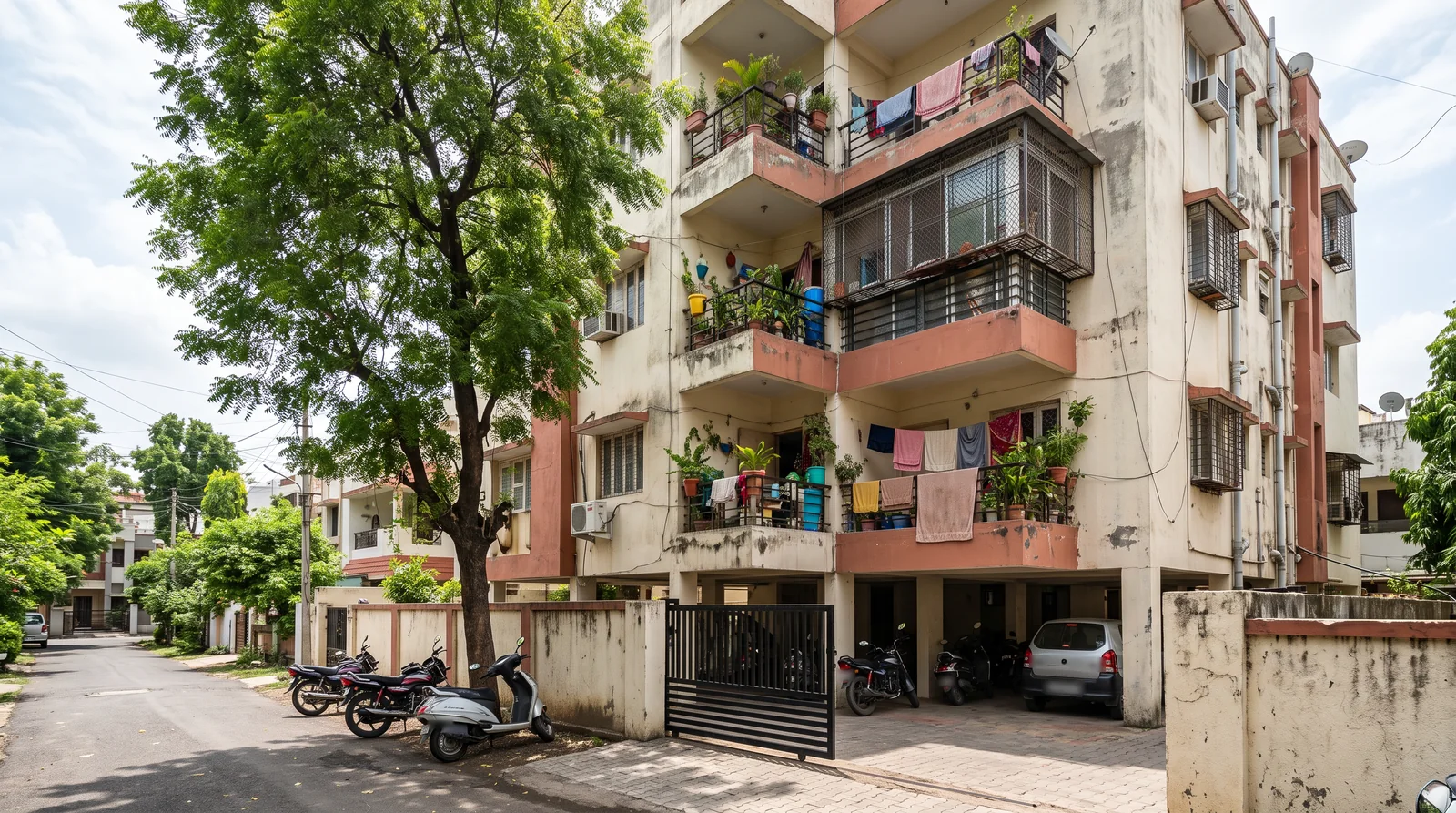
A resale flat is two purchases in one: the flat, and a fixed share of the land, stairs, lift and terrace. Before any token, check three things: the chain of registered deeds back to the builder, the building's own approvals, and the dues the seller leaves behind. One letter from the association caps those dues.
What the seller owns: a flat, and a share
In Madhya Pradesh, flats a promoter builds fall under the M.P. Prakoshtha Swamitva Adhiniyam, 2000, the state's apartment-ownership law. It splits what you buy in two.
The flat is yours alone, owned outright, to sell, gift or leave like any property.
The common areas are yours in common. Land, compound, stairs, lift, lobby and terrace belong to all the owners. Your part is an undivided share: your flat's built-up area over that of all the flats. It is fixed, and never sold apart from the flat.
The bills follow the share. Common expenses are split in the same percentage.
Eight flats of 1,000 sq ft each give every owner a 12.5 per cent share, and 12.5 per cent of the bills. Be sure which area the papers mean; carpet, built-up and super built-up differ.
The paper chain: one deed for every change of hands
The first owner received the flat from the builder by a deed of apartment, registered within three months. Every later owner bought by a registered sale deed. There should be one registered deed for each change of hands, then your own deed, with your undertaking.
On every deed in the chain, check that these line up:
- the flat number and floor;
- the area;
- that each seller was the buyer on the deed before;
- the share in the common areas;
- that there is no gap in the dates.
Lenders check it too: SBI asks for the originals of the whole chain on a resale. How a chain is read: clear title explained.
बीच की एक रजिस्ट्री ग़ायब है, तो आपकी रजिस्ट्री भी अधूरी है।
Beech ki ek registry gaayab hai, to aapki registry bhi adhoori hai.
The building's own record
The flat's deeds can be clean while the building's are not. On a resale SBI checks the title and sale deed, an encumbrance certificate and the latest tax receipts, and for the building, the occupancy certificate, the building plan approval and the possession certificate.
Four records belong to the building rather than the flat:
- The building permission: the sanctioned plan the block was built to.
- The occupancy certificate: the building is fit to live in (OC and CC explained). The association can be formed only after it.
- The colony's approval: the layout and zone of the land beneath.
- The association, registered through the SDO (Revenue), the competent authority under the Act.
Dues that follow the flat
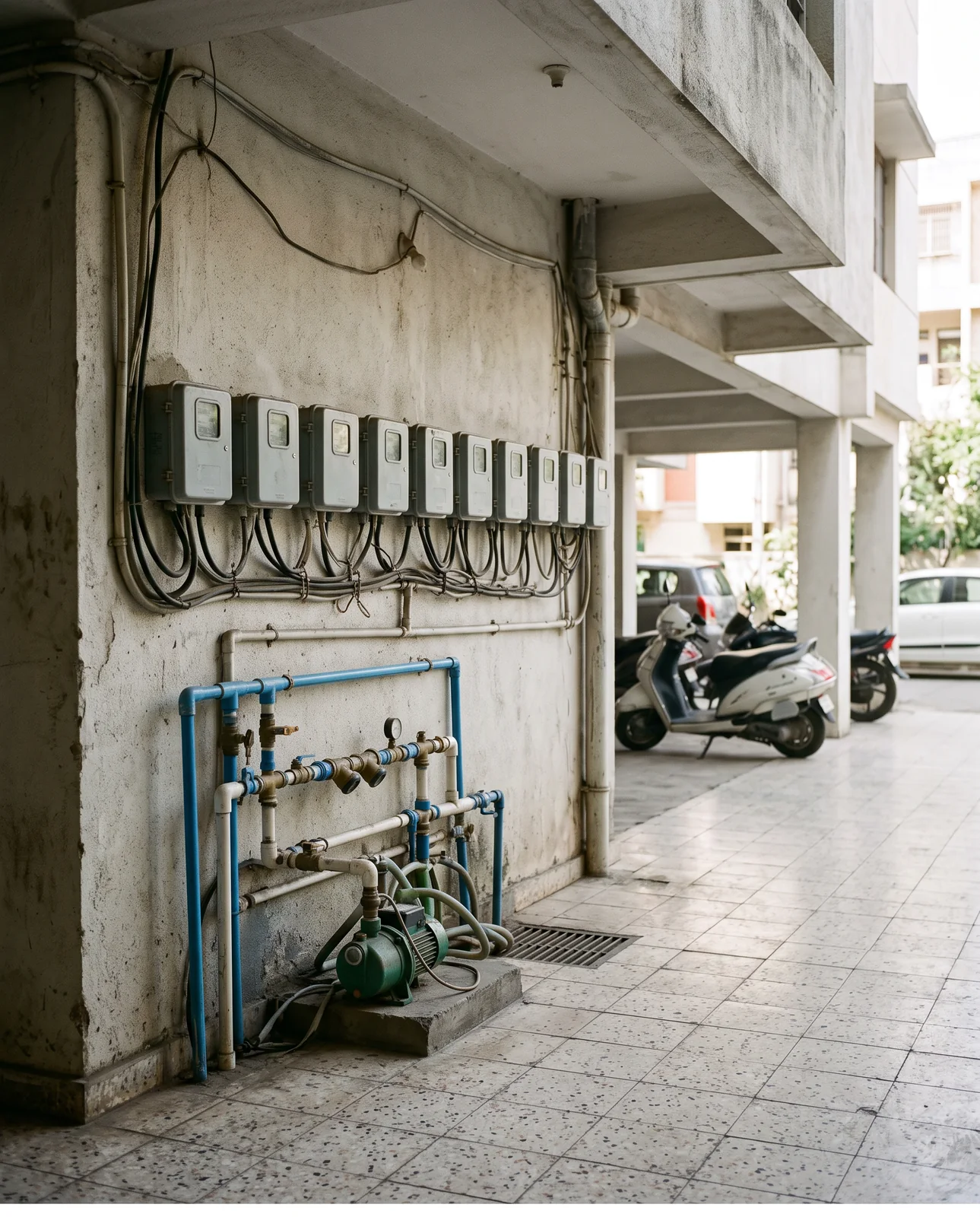
- Unpaid maintenance is a charge on the flat itself, not just a debt of the seller.
- Buyer and seller share the liability. Both are jointly and severally liable for dues up to the transfer. You can recover from the seller, if you can find the seller.
- One letter caps it. Ask the association's board for a statement of unpaid dues. You are not liable for more than that statement shows.
- Tax and power too. Property tax is a first charge on the building under the municipal law, and the discom will certify any electricity arrears on the connection if you ask.
The association: who runs the lift, and whom you pay
The association is formed after the occupancy certificate: the builder applies to register it, as a co-operative society or a company, within three months of a third of the flats being sold. It runs the common parts: upkeep, repairs, insurance, and assessing and collecting common expenses.
Membership is automatic for a buyer; the model bye-laws set an entrance fee of ₹1,000. Disputes over amounts payable go to the SDO (Revenue).
After the registry: three things in the first three months

- Register your undertaking within three months: an instrument promising to keep the building's covenants and bye-laws. A certified copy goes to the competent authority.
- Join the association. Pay the entrance fee, move the maintenance account into your name, file the dues statement.
- Tell the municipal corporation. Seller and buyer both give notice within three months of registration. Until it is recorded the seller stays liable for the tax, so the seller will help. Revenue mutation is separate: registry day and mutation.
चाबी मिल गई, पर तीन काग़ज़ अभी बाक़ी हैं।
Chaabi mil gayi, par teen kaagaz abhi baaki hain.
Six questions for the seller, before any money moves
- May I see every deed back to the builder, and the originals at the registry?
- Is there a loan on the flat? When will the bank's release and the original deeds be handed over?
- What is the monthly maintenance, and will you get me the association's statement of dues?
- Are property tax and electricity paid up to date? May I see the receipts?
- Does the building have its occupancy certificate?
- Has anything changed from the sanctioned plan, such as an enclosed balcony or a moved wall?
Check the building, not just the flat
The colony's layout, zone and record are what the whole chain stands on.
See it for yourself on the map — boundaries, plans and paperwork on one screen.
Look up the colony under the building: its layout, zone and record →Questions people ask
Am I liable for the previous owner's maintenance dues on a resale flat in MP?
Unpaid maintenance is a charge on the flat, and buyer and seller are jointly liable for dues up to the transfer. Ask the association for a statement of unpaid dues first; you are not liable for more than it shows.
What documents should I check before buying a resale flat?
Every registered deed back to the builder, the occupancy certificate, the building permission, the encumbrance certificate, the latest tax receipts and the association's statement of dues.
Is membership of the apartment owners' association compulsory after buying a flat?
Under MP's apartment-ownership law, a buyer becomes a member automatically. The model bye-laws set an entrance fee of ₹1,000.
How long do I have to tell the municipal corporation after buying a flat?
Seller and buyer must both give notice of the transfer within three months of registration.
Where the facts come from. The facts and figures in this post come from verified government sources and verified RERA-registered brokers.
Indori Zameen is a private platform. It is not a government body and is not affiliated with one — always confirm a record with the concerned authority before you commit money.
Share this post
Related posts
 Papers & law7 min read
साफ़ टाइटल एक ज़ंजीर है।
Papers & law7 min read
साफ़ टाइटल एक ज़ंजीर है।
Clear title is not a certificate: how to read the chain of title
Nobody issues a certificate saying your land is fine. Clear title is a chain of owners with no gap, traced back thirty years. How to read it, and its limits.
3 Oct 2026 Papers & law8 min read
CC और OC — बिना इनके क़ब्ज़ा मत लीजिए।
Papers & law8 min read
CC और OC — बिना इनके क़ब्ज़ा मत लीजिए।
Occupancy certificate and completion certificate: two papers, two jobs
A completion certificate says the building matches its plan. An occupancy certificate says you may live in it. Ask for both before you take the keys.
3 Oct 2026 Buying guides7 min read
आप किस एरिया का पैसा दे रहे हैं?
Buying guides7 min read
आप किस एरिया का पैसा दे रहे हैं?
Carpet area, built-up area, super built-up area: only one is defined by law
Three areas, one flat, and you are usually quoted the biggest. What carpet area means in law, and how to work out your real price per usable square foot.
3 Oct 2026 Money7 min read
बैंक क्या-क्या जाँचता है?
Money7 min read
बैंक क्या-क्या जाँचता है?
What the bank checks before it lends on a property
Before a home loan, a lawyer and a valuer examine the property at the bank's cost. What each one checks, and why a refusal is information.
3 Oct 2026Tagged flat, resale, checklist, sale-deed, imc, instagram-series.
Read it. Then check it on the map.
Every colony's boundary, its approved layout, its zoning and its paperwork — on one screen. Signing in is free.